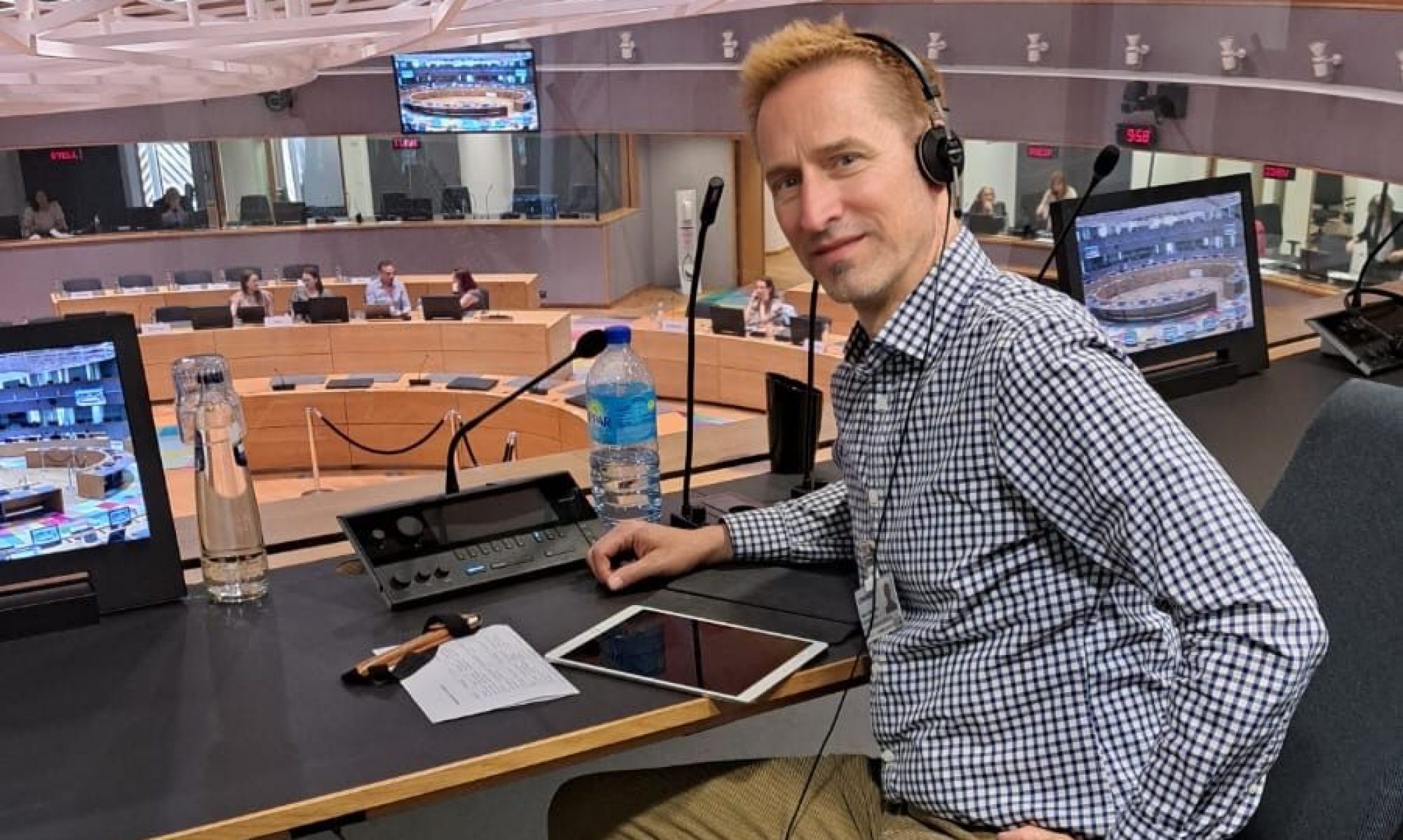


Recently, I encouraged a very dear colleague of mine to try Public Service Interpreting (PSI). The working methods and remuneration differ considerably from classical Conference Interpreting (CI). But I enjoy this work, especially to bridge the gap between bigger CI assignments .
Today reminded me why.
I joined an emergency video call with no briefing or context. Five participants were speaking with a gentleman whose words I struggled to follow. There were technical difficulties, and for the first ten minutes, I questioned the connection, my understanding of his accent, and myself.
Then I realised that what I was hearing suggested a psychotic episode.
His speech jumped between childhood, today and tomorrow. Between countries, people and events, there was no discernible connection. I was struggling because I was trying to piece together a coherent message.
But the fragmentation itself was the message1
As soon as I recognised this, I paused the interpretation to address the five other participants in my own capacity as the interpreter. I explained that the French speaker’s train of thought lacked any discernible coherence or connection.
Then I resumed interpreting.
Our responsibility as interpreters, at any level, is to communicate faithfully, without adding, omitting or changing meaning. Making someone’s words comprehensible cannot mean supplying connections they have not made. In this situation, doing so could have obscured something essential for those assessing his condition.
At the end of what turned into a two-hour call, I could not know what difference my contribution had made. I still cannot. But experiences like this make me reflect on the place PSI holds within our profession.
CI often carries greater visibility and prestige. PSI takes place in more personal settings: an examination room, an asylum centre, a police station or a video call. Yet, the responsibility we carry is the same. And it’s immense.
In that moment, we may not be helping avert the next world war or stock market crash. But we may be helping someone receive urgent care, explain their circumstances or be understood at a decisive moment in their life.
For that person, the stakes can be life or death.
PSI deserves the same professional respect as CI. Different skills and working conditions do not make it less important. These encounters call for trained professionals whose judgement matters as much as their language skills.
Colleagues working in either field: how do you see the relationship between the two? Do we, as CIs, give PSI the recognition it deserves within our own profession? I look forward to your comments.
- Image by Petra from Pixabay ↩
