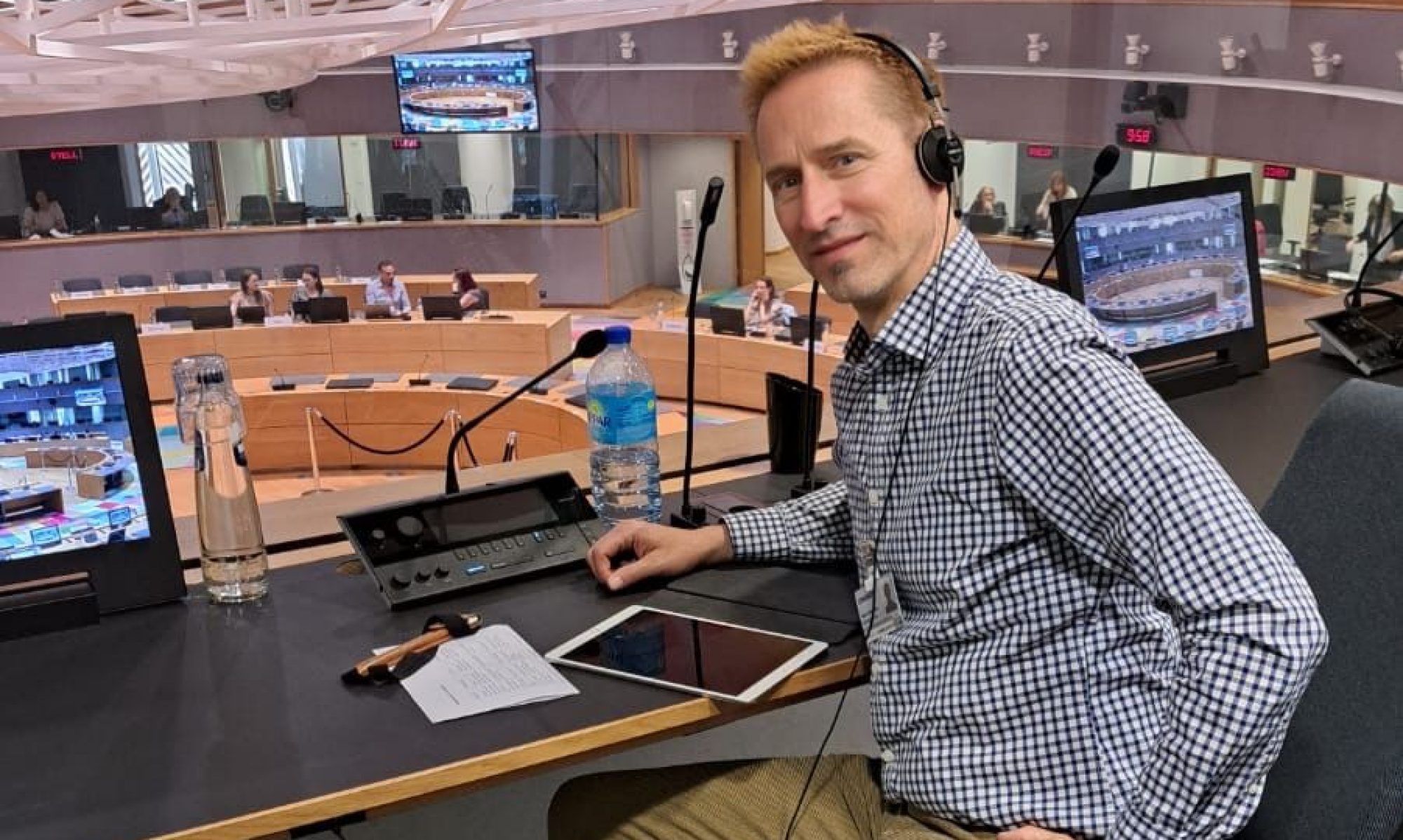
Healthcare. Self-care. Everywhere.

Funny how, even during these quieter summer days when the conference-interpreting world seems to slow down, life as a freelancer never really does.

As independent contractors, running our own businesses, we never quite stop. There is always something to do: finding new clients, growing the business, preparing for the next conference, studying, organising — planting seeds that might one day grow into another project.

Which brings me back to the title of this post: Healthcare. Self-care. Everywhere.

It was the title of an event curated by our wonderful principal tutor and mentor @Sandra Liepelt, but largely organised, shaped and brought to life by the students of the MA Conference Interpreting (#MAKD) programme at #HeidelbergUniversity.

There was a message running through that conference that has stayed with me: healthcare should know no boundaries — regardless of heritage, background, race or financial circumstances.

But there was another message, too.

We need boundaries.

Those of us who are independent, freelance, self-employed — whatever term we choose — need to remember to take care of ourselves as well.

So, on this bright and sunny Sunday, with temperatures finally back to something approaching normal, it feels rather good to put down the vocabulary lists. To sleep in a little. To take a long walk through the park. To stop for a cup of tea at a café along the way.

And to read a book that has absolutely nothing to do — or at least not directly — with any of my many professional and creative alter egos: #interpreter, #author, #publisher, #speaker, #coach, #singer, #dancer… Apparently, sitting still is not among them.

Healthcare. Self-care. Everywhere. Sometimes, self-care is simply allowing ourselves to stop.

Wishing you a lovely Sunday.

A Single Image Can Be a Game Changer

A picture is worth a thousand words1.

For interpreters, those words are more than a proverb. They are our method.

We are master linguists, yet we don’t get hung up on words. We work with concepts. That’s why our note-taking isn’t verbatim. We don’t necessarily write what was said; we capture what it means—using symbols, arrows and visual shorthand rather than complete sentences.

I’ve read a lot about the history of our profession and about interpreter cognition. One observation resurfaces again and again in the literature on interpreting: interpreters do not necessarily have photographic memories—but they do often have visual memories. Meaning is stored as imagery rather than text.

As a child, I struggled with numbers. Four-and-twenty. Six-and-fifty. Four twenties and ten… My brain simply refused to keep them in order. Then I discovered, if I could picture the numbers, then I could reproduce them. The image unlocked recall.

As it turns out, living inside a world of images is one of the things I love most about this profession. There is hardly a day that goes by without learning something new, solving a new puzzle, or finding a new visual connection to a difficult topic. I get through and master each day one image at a time.

Just recently, I worked on a high-stakes negotiation. My client was a French-speaking high-net-worth individual from an Arabic-speaking country. Her negotiating parties were German-speakers — representatives of major companies across Europe. The register was high on both sides. One of those assignments where conscious thought quietly steps aside and skilled execution simply takes over. The images in my head were clear. Everything landed exactly where it should. I left quietly satisfied and the client’s generous feedback suggested she was equally pleased.

A life of their own

But occasionally, the images in my head decide to take on a life of their own.

Last week, I had already finished my assigned caseload for the day, when I was approached to take just one more hearing. The scheduled interpreter was delayed and they needed someone now. All the info I was given for these legal proceedings was: a workers’ compensation case on unfair dismissal following an injury. Estimated hearing time: 30 minutes. The language pair was English / German — an Austrian legal team on the one side (not my native variety), and a very tall, broad-shouldered, deep-voiced American claimant on the other. Legal language. Medical terminology. Dialectal hurdles. Plenty to keep any interpreter (with or without prior preparation) on their toes.

The hearing commenced with general statements then came the routine question to the claimant.

“Sir, please state your profession for the record.”

“I’m a professional hockey player.”

Given all the euphoria at the moment around the Football World Cup dominating every screen, you’d think my brain might have conjured up football pitches, nerve racking penalty shoot-outs sans fin or even late-night calls from heads of state about a clearly unreasonable red card.

Wrong.

My visual memory took a very unwanted turn and decided to revisit a recently released HBO hockey series instead. The moment I heard the words, “I’m a hockey player,” the assignment became a high-stakes juggling act between professional Conference Interpreting and an imagination that had quite clearly decided to skate off in a different direction.

I was desperately trying to convince my visual memory that Austrian led courtroom proceedings had absolutely no place for testosterone-filled locker rooms, clouds of steam, impossibly broad shoulders and an inordinate number of over-muscular backsides. Suddenly, my visual memory had become my own Heated Rival.

Somehow, my professional brain won!

Interpreters aren’t machines. We process language through concepts, and, for many of us, those concepts arrive as images. Most of the time those images are our greatest ally. They anchor meaning, support recall and allow us to recreate a speaker’s ideas with remarkable precision. However, every now and then, those same images decide to entertain themselves.

La fin du conte ?

The record was accurate. The legal reasoning remained intact. Professional dignity survived. Once again, I was reminded that a single image really can change everything.

Every profession has its stories. Ours unfolds one image at a time.


Before I raise a glass to our brilliant profession, I’d love to hear your stories. Have you ever taken an unexpected mental detour? Has your imagination ever become your greatest ally—or your most heated rival?

  1. Image by gerren0 from Pixabay

Interpretation Spot On — LinkedIn Had Other Plans

I checked: no hacking, no mysterious strategy, no sudden “editorial comeback.”

Simply proof that in 2026 one can work perfectly in French, English and German — while remaining almost completely illiterate in computer speak.

Meanwhile, LinkedIn decided yesterday — apparently sans raison — to resurrect a number of old posts all by itself.

Human languages: no problem.
Digital platforms: complicated relationship.

Give and you shall receive

give_pic

Interestingly, the title phrase of this post, while often associated in the West with Christianity, conveys a sentiment found in various cultures and religions around the world*. Let us consider a compelling German saying that conveys a nearly identical message yet from a unique perspective:

Von Nichts, kommt nichts!

A straightforward interpretation of the German idiom might be:

  • Out of nothing comes nothing, or simply,
  • Give nothing. Get nothing.

Expanding this thought, however, can lead us to deeper expressions like:

💡 S(he) who sows no seeds will never harvest any fruit.

    As interpreters, we appreciate the nuances of language and the underlying principles of communication. Our work is not merely about converting words from one language to another; it’s about understanding context, intent, and the emotional resonance of what is being conveyed. This is where the “artistic aspect” of interpretation comes into play. Each seemingly simple phrase can blossom into something profound when considered deeply.

    The essence of giving and receiving is a universal principle, its application, however, varies across different contexts. It is in this variation that the beauty of our work lies. For interpreters must always be mindful of not just the literal meaning of words, but also the intention and nuance conveyed within the context.

    NB: This insight into the complexities that unfold in the minds of every well-trained Conference Interpreter may not always be immediately apparent to those who engage our services. So, if you work with interpreters, remember these words the next time you step up to the mic at an international conference:

    Our ethos at RvL Consultants isYour words. Our expertise. Global impact.

    *The theme of reciprocity, articulated here as ‘Give and you shall receive,’ can be found across various cultures and philosophies, including the biblical excerpt from Mark 6:38.

    Urbi et Orbi

    A poetic contribution for Easter 2025

    Though today may not be a holy day for everyone, it is a day where all cultures, countries and peoples alike can be moved to rejoice and celebrate in one common goal of pace !

    Pour que les feux cessent !
    May, from today, only peace progress !
    Frieden auf dieser Erde sei unser Profess !


    Richard v. Lothringen
    Conference Interpreter & Public Speaker E/D/F
    London / Frankfurt / Paris

    Auch Kleinvie macht Mist

    l'il cowbow

    (or for a less visual English Interpretation)

    The Future will come slowly but surely1

    In recent weeks, after completing my MA in Conference Interpreting (E/D/F), I often think back to all the little words of wisdom my grandmother shared with me—wise words about courage, success and patience. Funny enough, one in particular keeps coming back to me: “Auch Kleinvieh macht Mist.”

    Now, the literal meaning—“Even small livestock make manure”—might not sound like an inspiring motto, but trust me, it rings true in more ways than one:

    – Confidence and courage
    – Investment and return
    – Growth and stability

    Confidence and courage: Fresh out of the professional starting blocks, we are no longer students. We have to hold our heads high and keep our sights on the finish line. And right now, that finish line feels a bit like a small livestock farm—sure, we may not be taking a prize bull to market just yet, but even a few chickens and goats can keep us going. Every small win counts!

    Investment and return: We’ve got the farming theory—now it’s time to put it into practice. That means rolling up our sleeves, turning the soil, planting different crops, and letting the herd (small or large) graze. The first harvest might not be as grand as we’d like, but with patience and effort—including a good amount of organic compost—the returns will grow!

    Growth and stability: Because, at the end of the day, every little bit adds up. Today’s small investments—whether in skills, networking, or experience—become the solid foundation for tomorrow. Even the tiniest farm animals eventually produce a manure pile big enough to fertilise an entire field.


    The Village Registrar in Weinheim

    Just finished an assignment at a medieval Registrar’s Office located inside an old castle in a village on the outskirts of Heidelberg. A lot of legal jargon, a fair bit of sight translation, and some fun new terms for my glossary. Small job? Sure. But, as the saying goes—even small livestock make manure.

    A huge thanks to my University Lecturer, Mentor, and fellow interpreter @Sandra Liepelt for passing this opportunity my way. Every small step leads to the next. Excited for what’s to come!

    [^1]

    1. I feel a speech coming on—nudge to @Bernd Mischke ↩︎